
A dental postcard has two jobs: bring in the patients you want, and stay inside your provincial college's advertising rules. Many dental postcards reach for a free exam, a new-patient discount or a patient quote, which the Saskatchewan and Ontario colleges restrict. This guide covers what the Saskatchewan and Ontario colleges allow on a card, the two mailings worth running, and how to tell whether the cards worked.
Our Position
- Mail your own lapsed patients first. A recall card to someone who is overdue, often a year or more since their last visit, usually costs less per booked appointment than any cold mailing, and it needs no offer at all.
- Use Postal Code Targeting around the clinic for acquisition, with a plain message: who you are, where you are, when you are open, that you are accepting new patients, and how you bill.
- Count attended first appointments, not calls. A card that fills the phone with people who never show up is not working.
What the College Rules Say
Saskatchewan: the College of Dental Surgeons of Saskatchewan's bylaws require every registrant to follow its Advertising Standard, which was last amended in September 2025. Section 14 says advertising must not include personal feelings, opinions or testimonials. Section 15 says advertising should not include incentive programs, coupons, giveaways and discounts, and section 18 lists flyers among the forms of external advertising those rules cover.
The same Standard separates internal advertising, meaning material sent to patients of record and people who opted in, from external advertising. Internal advertising must still be accurate, verifiable and professional, but section 15's list does not apply to it. That distinction is why a recall card to your own patients and a postcard to the neighbourhood are planned differently.
Ontario: the Royal College of Dental Surgeons of Ontario's advertising guidance says not to include testimonials, or incentive programs including giveaways, contests, draws, or free products or services. Fees may be advertised if they are clearly stated.
| On the card | Saskatchewan, to the public | Ontario |
|---|---|---|
| Patient testimonial or quote | Not allowed | Not allowed |
| Free exam, whitening or gift | Not allowed (giveaway or incentive) | Not allowed (free products or services) |
| Discount or coupon | Not allowed | Not named; treat as an incentive and ask the college |
| Fees, stated plainly | Allowed if accurate and verifiable | Allowed if clearly stated |
| Hours, location, dentists' names, new patients welcome | Allowed | Allowed |
This is our reading of the rules for marketing purposes, not legal advice. Each college reviews advertising complaints itself, so when a card is close to a line, ask the college or your own advisor before it prints.
Mailing 1: Recall Cards to Your Own Patients
Your practice software already knows who is overdue. A recall card goes to patients who have not booked in a set period, by name, with a booking link. It has no offer because it does not need one: the reason to call is that they are due. On the card below we also give the patient a way to tell the clinic they have moved on, which keeps the list clean and keeps the clinic from mailing people who have left.
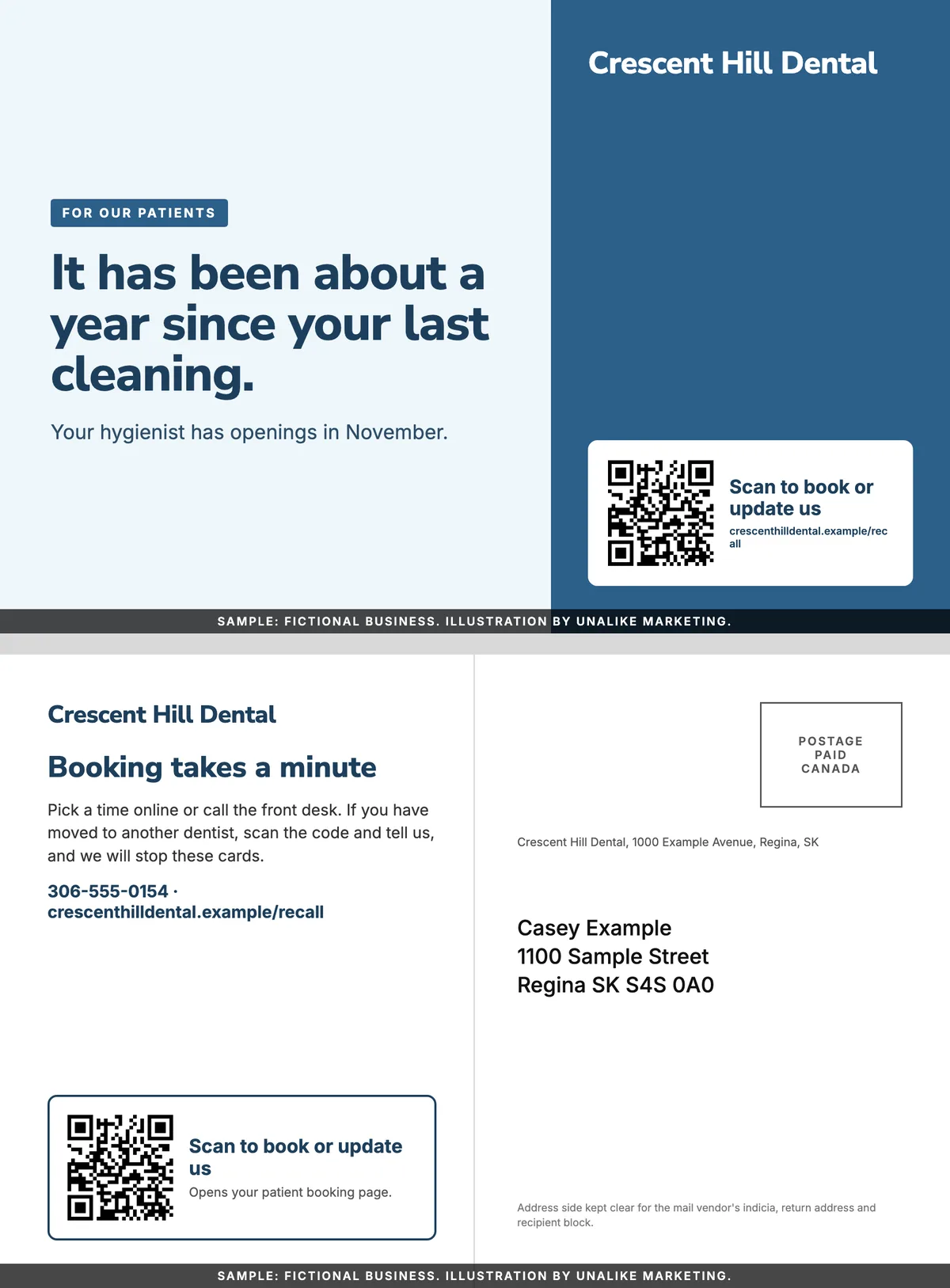
Patient contact details come out of the clinic's health records, and a reminder that a patient is due for care is a different use of them from a promotional mailing. Have your privacy officer confirm which one your card is, and that the use is permitted, before the list leaves the practice software.
Mailing 2: New-Patient Cards Around the Clinic
For acquisition, Postal Code Targeting delivers to every address in the postal codes you choose, without buying a list. Pick the codes inside a realistic drive time and leave out the ones where a competing clinic is closer. The card states facts a prospective patient needs: the dentists' names, the address and parking, evening or weekend hours, that you accept new patients, that you bill insurance directly, and whether you accept the Canadian Dental Care Plan.
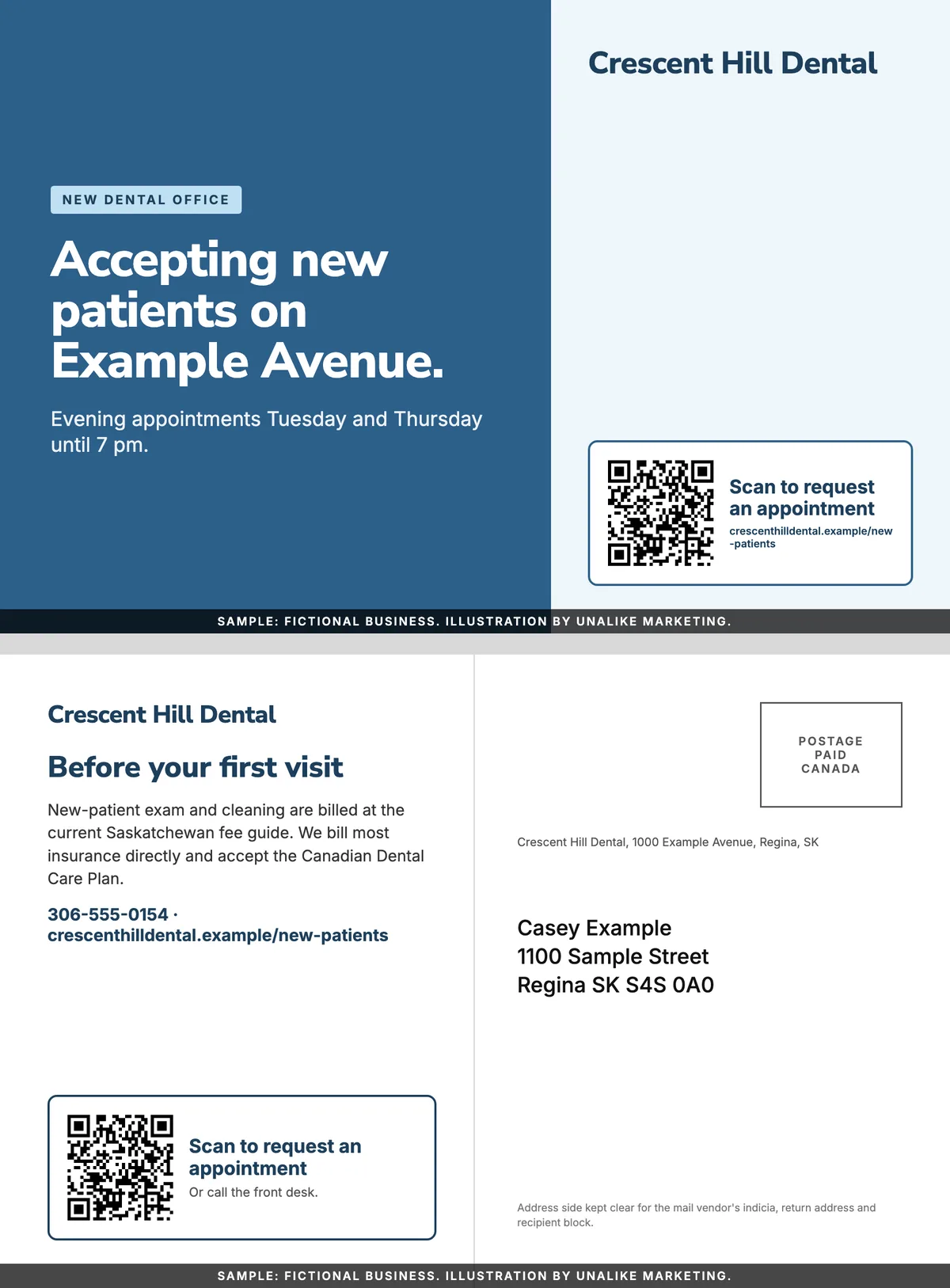
Notice what the card leaves out: no free exam, no discount, no gift card, no patient quote and no before-and-after photo. Fees are stated as billed at the provincial fee guide rather than as a promotion.
How to Measure It
- Give the mailing its own response path: a QR code to a page made for that mailing, and a call-tracking number on the card.
- Ask every new patient how they heard about the clinic, and record the answer in the practice software, not on a sticky note.
- Report four numbers separately: calls and scans, booked first appointments, attended first appointments, and patients who return for a second visit.
- Divide the full cost (design, print, postage, tracking) by attended first appointments. That is the cost per new patient, and the only number worth comparing against Google Ads or a referral program.
In our experience people often act on a card weeks after it arrives, when a filling breaks or an insurance year resets, so judge a new-patient mailing after eight weeks, not one.
Work We Have Done for a Dental Clinic
We have produced print for Boulevard Dental in Saskatoon, including postcard mail-outs, signage and posters, with content, design and print coordination handled in-house. The real postcards are in that case study; the cards on this page are fictional illustrations.
Our direct mail service page explains how we run a program end to end, and our dental marketing hub covers search, reviews and the rest of a clinic's marketing.