Healthcare Marketing for Canadian Clinics
Is Your Clinic Showing Up When Patients Ask AI? An AI Visibility Audit
By Kyle Senger
15+ years in local marketing; Google Ads certified; Shopify Partner.
TLDR
Canadian clinics can audit their AI visibility in 60 minutes by running 10 patient-phrased queries across ChatGPT, Google AI Overviews, Perplexity, and Gemini, producing 40 data points that reveal whether the practice appears in AI-generated answers.
- Why it matters: AI search visibility pulls from different signals than Google rankings, so a clinic can hold the top organic position for "family doctor Regina" and still be absent from every ChatGPT answer.
- What wins: clinics named in AI answers consistently have structured About pages, practitioner bios with credentials and registration years, and FAQ pages written in plain question-and-answer prose.
- Scoring: 0-2 mentions out of 40 is Bucket A (invisible), 3-15 is Bucket B (sporadic), 16+ is Bucket C (dominant).
- Timeline: Perplexity and ChatGPT respond to structured content changes within 60-90 days; Google AI Overviews take 4-6 months.
- Compliance: every page published for AI visibility must clear provincial college advertising rules, including CPSO Policy in Ontario and CPSBC Professional Standards in BC, before it goes live.
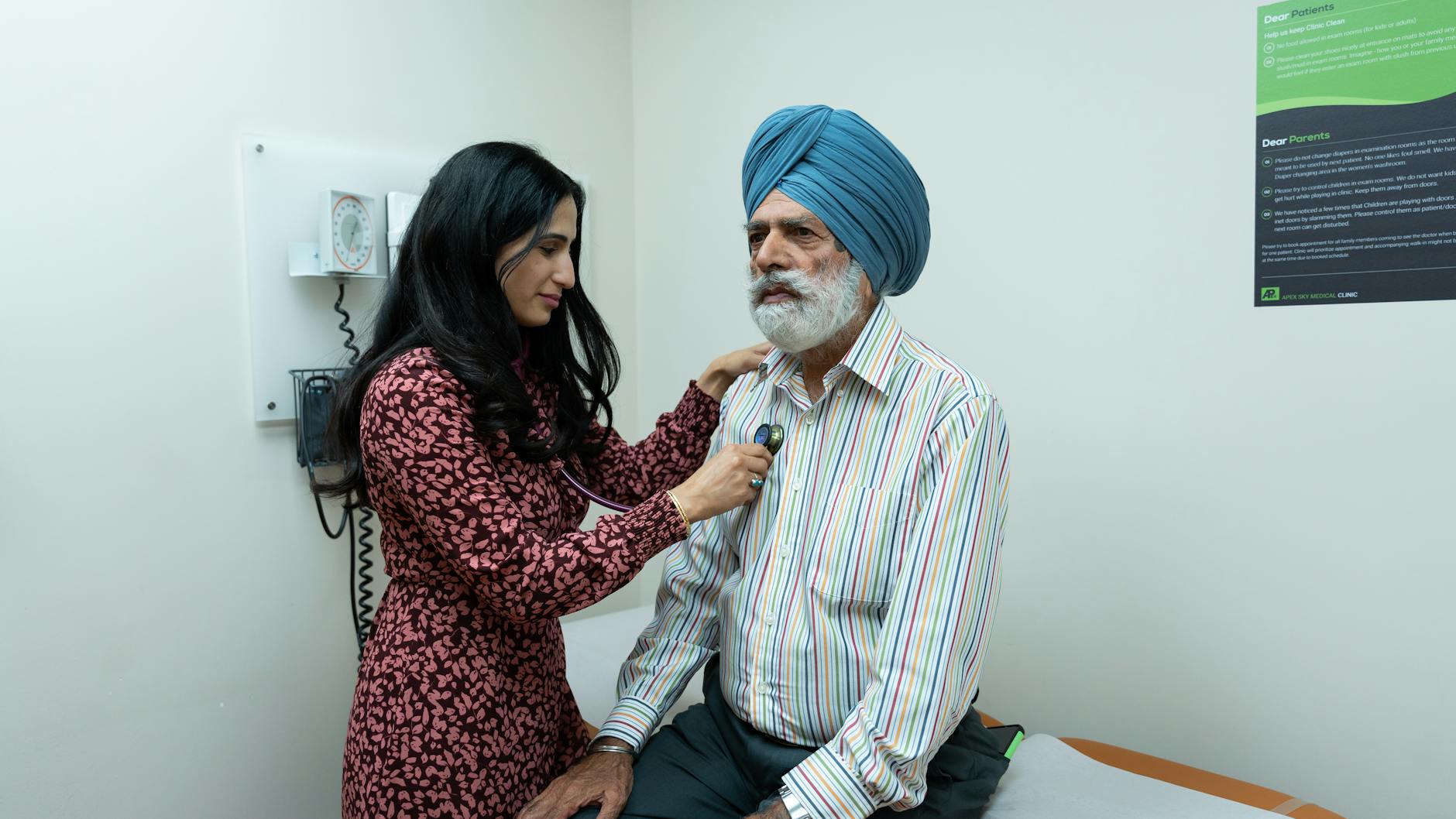
Picture this. A mom in Saskatoon has a kid with an earache at 9pm on a Tuesday. She doesn't Google "walk-in clinic Saskatoon" anymore. She opens ChatGPT and types "where can I take my 6-year-old for an earache tonight in Saskatoon." The AI gives her three options. Your clinic is open. Your clinic is one block closer than the one she picks. But your clinic isn't in the answer.
That's the clinic ai visibility problem in one sentence. Patients are asking AI instead of Google for a growing slice of health queries, and most Canadian practices have no idea if they show up in those answers, let alone how to audit it. This subpage is a walkthrough of how to check, in about an hour, whether your clinic is visible to ChatGPT, Google's AI Overviews, Perplexity, and Gemini. I'm not going to cover the full medical SEO picture here, that's what our complete guide to medical SEO is for. This is narrower. This is the audit.
Here's the thing. AI visibility is not the same as Google ranking. You can be the #1 result for "family doctor Regina" and still be invisible to someone asking Perplexity the same question. They're different systems pulling from different signals. So an audit for one is not an audit for the other.
Let's get into it.
Why AI Visibility Is a Separate Problem From SEO
When someone Googles "chiropractor Calgary," Google shows a map pack, some ads, and ten blue links. You know what that looks like. You can check your ranking in a browser window in ten seconds.
When someone asks ChatGPT the same thing, the AI writes a paragraph. Maybe it names three clinics. Maybe it describes what to look for but names nobody. Maybe it tells the patient to "consult a licensed provincial directory." Every answer is different. Every user's answer is slightly different. And the signals that got your clinic into the answer are not the same signals that got you to #1 on Google.
Per the 2024 Perplexity/Environics reporting cited in our research, patient query behaviour is shifting toward symptom-based and question-based discovery through AI assistants, with local Google Business Profile signals still mattering but no longer being the only game. That's the piece most agencies are missing. They're still selling you SEO like it's 2019.
In my experience, practices that have solid local SEO but zero AI presence are the most common pattern I see right now. Good reviews, clean Google Business Profile, decent organic rankings, completely invisible on ChatGPT. It's not because they did something wrong. It's because AI systems pull from a different blend: structured content, authoritative mentions, Wikipedia-style factual references, and direct crawls of your site in a way Google doesn't do.
So the audit has to check all four major AI surfaces separately. Here's how.
The 60-Minute Clinic AI Visibility Audit
This is the exact process. Block an hour. Open a fresh browser window in incognito mode so your account history doesn't skew results. Have a notebook or a spreadsheet ready.
Step 1: Define your 10 audit queries (5 minutes)
You need a list of the questions a real patient would ask an AI about your practice type and location. Not keyword-stuffed SEO phrases. Real human sentences.
For a family doctor in Regina, that list might look like:
- "Family doctor accepting new patients in Regina"
- "Where can I find a GP in Regina that takes walk-ins"
- "Best family clinic in south Regina"
- "Family doctor near me in Regina covered by Saskatchewan health"
- "What family doctors in Regina speak Tagalog" (or whatever your clinic actually offers)
- "Family doctor in Regina open Saturdays"
- "New patient family physician Regina"
- "Regina clinic that does annual physicals"
- "Pediatric family doctor Regina"
- "Most recommended family doctor Regina"
Write these the way your patients would ask. If you serve a specific neighbourhood, include it. If you have a specialty, include it. Generic lists don't tell you anything useful.
Step 2: Run each query on 4 AI surfaces (30 minutes)
Test every one of those 10 queries on:
- ChatGPT (the free version, logged out or incognito)
- Google AI Overviews (just Google the query on a logged-out Chrome session)
- Perplexity (perplexity.ai, it cites sources, which makes it useful)
- Google Gemini (gemini.google.com)
For each query on each surface, record three things:
- Did my clinic get named? Yes or no.
- If no, who did get named?
- What source did the AI cite, if any?
That's it. 10 queries × 4 surfaces = 40 data points. Takes about 30 minutes if you move.
Step 3: Categorize the results (10 minutes)
You'll end up in one of three buckets.
Bucket A: Invisible. Your clinic is named in 0-2 of the 40 tests. This is where most Canadian clinics sit. Not a disaster, but it means you've done nothing deliberately for AI visibility yet.
Bucket B: Sporadic. Named in 3-15 of the 40. You show up, but inconsistently, and usually on queries where there are few competitors. You've got a foundation, but you're not dominant.
Bucket C: Dominant. Named in 16+ of the 40. Rare. If you're here, keep doing what you're doing, and your bigger priority is protecting the position.
Step 4: Look at who's winning (10 minutes)
On the queries where you lost, who did the AI name? Click through to their site. What do you notice?
Usually it's one of these patterns:
- A clinic with a long, detailed "About" page that reads like a mini-Wikipedia entry
- A clinic with a robust FAQ page that answers specific patient questions in complete sentences
- A clinic that's been quoted in CBC, CTV, or a local newspaper in the last 2 years
- A clinic with a physician bio page that lists credentials, training, languages, and areas of focus in plain structured prose
That's not coincidence. Those are the signals AI models weight heavily. Authority, specificity, structured factual content.
Step 5: Note any compliance red flags (5 minutes)
This is a Canadian-specific step and most audits miss it. When the AI describes your clinic, does it say anything that would violate your college's advertising rules? I've seen AI answers describe a chiropractor as "the best in Ontario for back pain relief," which under CCO (College of Chiropractors of Ontario) and CCA voluntary ethics guidelines would be a flaggable comparative + outcome claim if it appeared on the clinic's own site.
The AI is pulling that language from somewhere, usually a directory, a third-party review aggregator, or an old piece of content. You need to know it's out there. CPSO's Advertising Policy (per cpso.on.ca/physicians/policies-guidance/policies/advertising) prohibits testimonials of specific outcomes, guarantees, and comparative claims. If an AI answer is repeating content that violates those rules, even if it's not on your site, your college may still ask you about it.
Write down anything sketchy. We'll come back to it.

A Worked Example: What 40 Data Points Actually Tell You
Let's say you ran the audit for a physiotherapy clinic in Vancouver. Results come in:
- Named in 4 of 40 (10%). Bucket A, bordering on Bucket B.
- Of those 4, three were on Perplexity and one was on ChatGPT.
- Zero mentions on Google AI Overviews or Gemini.
- The winning clinics had detailed physio bios, specialty-specific service pages (pelvic floor physio, sports physio, vestibular physio), and FAQ pages structured as Q&A.
The math isn't complicated. Per DataForSEO, "physiotherapy marketing" in Canada has CPC around CA$24.20 and "physiotherapy seo" runs CA$32.36. If you're already spending, say, CA$3,000/month on Google Ads at an average CPC of CA$24.20, that's roughly 124 clicks a month. Assume a booking rate of 4-6%, the same range cited for Canadian laser services in the research above (since clinic-specific Canadian physio conversion data wasn't available, check your actual number in your practice management software). That's 5-7 new patients from paid.
Meanwhile, the AI-visible competitor is showing up in a meaningful percentage of queries for free. If AI-driven patient discovery grows to even 15-20% of your inquiry volume over the next 18 months, and you're invisible, you're essentially paying Google Ads to backfill demand you should be capturing organically through AI. That's the cost of ignoring this.
What to Do With Your Audit (The 8-Week Plan)
I'm not going to give you a 30-day miracle plan because AI visibility doesn't work that fast. Here's what actually happens week by week when a practice decides to fix this.
Week 1: Run the audit above. Document the 40 data points. Identify the 3 specific queries you most want to win (usually the ones with the highest purchase intent: "accepting new patients," "near me," specialty + city).
Week 2: Rewrite your homepage and "About" page to be structured and factual. AI models reward content that reads like an encyclopedia entry. Who you are, where you are, what you do, who you serve, what provincial college regulates you, what languages your team speaks, what insurance or provincial plans apply (MSP in BC, OHIP in Ontario, AHCIP in Alberta, etc.). Plain prose, complete sentences, no fluff.
Weeks 3-4: Build out a proper FAQ page. 15-25 questions that real patients ask, answered in 2-4 sentences each, written in the same question-answer format patients would use with ChatGPT. Example: "Do I need a referral to see a physiotherapist in BC?" "No, physiotherapists in British Columbia are primary care providers. You can book directly without a doctor's referral, though some extended health plans may require one for reimbursement." That kind of structure is catnip for AI.
Weeks 5-6: Fix your practitioner bios. Each provider should have a structured bio page: credentials (with the actual degree and year, like "DC, CMCC 2015"), licensing body and registration number, languages, areas of focus, training, teaching appointments if any. AI models love this. So does Google's E-E-A-T.
Week 7: Get structured data on the site. Schema markup for MedicalClinic, Physician, FAQPage, LocalBusiness. This is technical but not hard; your web developer can do it in a day. Helps both AI and Google parse who you are.
Week 8: Re-run the audit. Same 10 queries, same 4 surfaces. Compare to Week 1. You probably won't see dramatic movement in 8 weeks, but you should see directional movement on Perplexity and ChatGPT first (they re-crawl more aggressively than Google AI Overviews). Full shift usually takes 4-6 months.
Typically, practices that invest in structured content and bio pages see their first AI mentions land within 60-90 days on Perplexity and ChatGPT, and within 4-6 months on Google AI Overviews. Gemini is the slowest to adapt, in my experience.
Compliance While You Do This (Don't Skip)
One more thing. Everything you publish to make yourself AI-visible has to clear your provincial college first. I can't stress this enough. Under CPSO Policy (Ontario), CPSBC Professional Standards (BC), and CPSA guidelines (Alberta), you cannot publish testimonials of specific outcomes, guarantees, or comparative claims against other practitioners. Chiropractic has additional CCA voluntary ethics rules against claims of "curing" specific conditions. Vets have binding OVMA/CVMA-BC/AVMA rules.
So when you write your FAQ page and you're tempted to include "How quickly will physio fix my back pain?" with an answer that implies a specific outcome, stop. Rewrite it. "What does a typical physio treatment course look like for low back pain?" and describe the process, the assessment, the range of treatment lengths, without guaranteeing anything.
For the deep dive on this, see our breakdown of AI-generated patient education content and provincial college rules. There's also a sibling piece on AI intake and scheduling tools reviewed for Canadian clinics if you're thinking about the operations side, and one on what to tell patients who ask if ChatGPT will replace their doctor which is becoming a real question in exam rooms.
If you're a specific specialty, the subpages get more tactical: chiropractic marketing, physiotherapy marketing, veterinary marketing, optometrist marketing, and the general medical practice and doctor marketing guide.
The Three Things to Remember
First, clinic AI visibility is a separate discipline from SEO, and being invisible on AI does not mean your SEO is bad. It means you haven't done the specific work AI systems reward: structured content, authoritative bios, FAQ pages, schema markup.
Second, the audit is cheap. An hour, 10 queries, 4 surfaces, 40 data points. You can do it today. You should do it today. Because if you don't know your baseline, you can't improve it.
Third, compliance eats marketing. Every single thing you publish to improve AI visibility has to clear your college's advertising rules first. A 20% increase in AI mentions is worthless if it triggers a CPSO letter. Goes back to the core point: the agencies that don't know Canadian regulations are the ones getting their clients into trouble, and AI is just the newest surface where that happens.
If you want us to run the audit for your practice, we can. Or take the framework above and run it yourself. Either way, check. Right now, most of your competitors aren't checking. That window won't stay open forever.