
Trucking Marketing for Canadian Fleets
Trucking Website Design: What Owner-Operators Actually Click
By Kyle Senger
15+ years in local marketing; Google Ads certified; Shopify Partner.
TLDR
Trucking websites fail Prairie carriers because most are built as brochures, not conversion tools, leaving shippers and Class 1 drivers with no clear path to act, while lane-specific pages and honest pay ranges fix both problems.
- Two audiences: shippers need lane, equipment, and NSC safety rating information; drivers need pay ranges, real home time, and equipment specs, served on separate pages.
- Driver compliance: post-Bill C-86 CRA enforcement means "be your own boss" recruitment language on carrier sites creates real tax classification exposure.
- Lane SEO: DataForSEO Canadian data shows low search volume for trucking terms, so a single page targeting "flatbed carrier Regina to Edmonton" faces almost no competition.
- Driver shortage: Trucking HR Canada 2024 projects a 55,000-driver national shortfall by 2030, making a sub-three-minute mobile application form a direct retention tool.
- Build cost: a 5-50 truck carrier site runs CAD $5,000 to $15,000; larger builds with driver funnels run CAD $15,000 to $30,000.
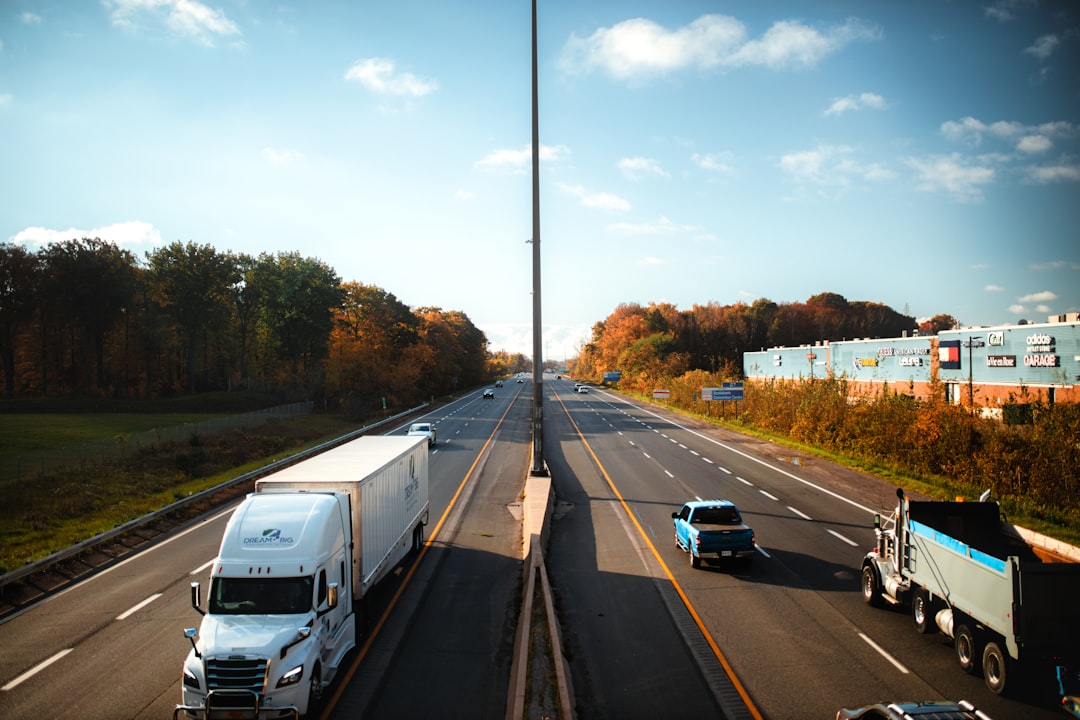
Picture this: you run 35 trucks out of Regina. You spent $12,000 on a website two years ago. It looks clean. Your logo is on it. There's a stock photo of a Peterbilt that isn't yours.
And it has generated exactly zero shipper inquiries.
That's the trucking website design problem most Prairie carriers are sitting with right now. The site exists. It just doesn't work. And the reason isn't usually the design itself , it's that nobody built it to do a specific job. No driver recruitment funnel. No lane-specific SEO. No reason for a shipper to call you instead of posting to Loadlink.
This article is about fixing that. I'm going to walk through what actually matters in a trucking website: what owner-operators and drivers click, what shippers look for before they pick up the phone, and what most agencies get completely wrong when they build sites for carriers. If you want the broader picture of how website fits into your overall marketing spend, our complete guide to trucking company marketing covers that.
What this article won't cover: general digital marketing strategy, paid ads, or social media. Those are real topics, but they're different jobs.
The Two Audiences Your Website Has to Serve (And Why Most Sites Fail Both)
Here's the thing most web designers miss. A trucking website isn't like a restaurant website or a dental clinic website, where basically everyone landing on it has the same goal.
Your site has two completely different audiences with completely different needs.
Audience one: shippers and freight buyers. They want to know if you can handle their lane, your equipment type, your safety record, and whether you're reliable. They're evaluating you like a vendor. They're probably comparing you to two or three other carriers. They don't care about your company history. They care about whether you run flatbed or dry van, whether you're FAST/PIP certified for cross-border work, and whether they can find your safety rating.
Audience two: Class 1 drivers. They want to know what you actually pay, what the home time looks like, what your equipment is like, and whether your dispatcher is a nightmare. They're evaluating you like an employer. And they've been burned before by carriers who promised "flexible home time" and delivered something completely different.
Most trucking websites I look at try to serve both audiences with the same generic homepage copy. "Reliable freight solutions since 1987." That sentence means nothing to either group.
The fix isn't complicated. It's two separate paths on the same site. A shipper lands and finds: lanes, equipment, certifications, request a quote. A driver lands and finds: pay structure, home time, equipment age, apply now. You can do this with clear navigation, separate landing pages, or both.
I think that's the piece most generic agencies miss. They build a brochure. You need a funnel.
What Shippers Actually Look For Before They Call You
I've looked at a lot of trucking websites across Saskatchewan, Alberta, and Manitoba. The ones that generate shipper inquiries have a few things in common.
They're specific about lanes and commodities. Not "we haul freight across Western Canada." Something like: "Flatbed lanes: Regina to Edmonton, Calgary to Saskatoon, Saskatchewan oilfield and ag freight." That specificity does two things. It tells a shipper immediately whether you're relevant to their load. And it's what Google actually indexes when someone searches "flatbed carrier Regina to Edmonton."
This goes back to a basic SEO principle. SEO, meaning search engine optimisation, is just making sure Google can understand what your site is about so it shows up when someone searches for it. Generic copy doesn't rank. Lane-specific, equipment-specific, commodity-specific copy does.
They show real equipment. Not stock photos. Actual photos of your trucks, your trailers, your yard. A shipper evaluating a 50-truck flatbed carrier wants to see your actual deck trailers. A driver wants to see if your trucks are maintained or if they're held together with zip ties and optimism. Real photos build trust in about three seconds. Stock photos do the opposite.
They make the safety rating findable. Under National Safety Code Standard 7, your carrier safety rating is public. Shippers know this. Some of them check it before they call. If your site doesn't reference your safety rating, or at least makes it easy to find your NSC carrier profile, you're leaving trust on the table.
They have a clear, low-friction quote request. Not a five-field contact form that asks for your life story. Something like: origin, destination, commodity, equipment needed, and a phone number. That's it. The easier you make it to start a conversation, the more conversations you get.
Across carriers I've worked with, the ones with lane-specific pages and a simple quote form get meaningfully more shipper inquiries than carriers with identical traffic but a generic homepage. The traffic isn't the problem. The site's job is to convert that traffic into a phone call.
What Drivers Actually Click (And What Kills Applications)
Driver recruitment is where most trucking websites fall completely flat. And it's not just a design problem , there are real compliance issues baked into how a lot of carriers talk about driving jobs online.
Let me start with the compliance piece, because it matters.
Post-Bill C-86 and ongoing CRA enforcement around Driver Inc arrangements, you cannot use marketing language that implies independent contractor status for a driver who is functionally an employee. Phrases like "be your own boss" or "run your own business" on a driver recruitment page can create real tax classification exposure. If you're running a Driver Inc arrangement, talk to your lawyer about what you can and can't say. If your drivers are employees, make that clear and make it a selling point , because a lot of drivers are tired of the Driver Inc grey zone.
Similarly, under Transport Canada's Hours of Service regulations and the ELD mandate that's been in place since June 2021, you can't promise "unlimited home time" or "flexible scheduling" if your operation doesn't actually support that. Drivers talk. If your website says one thing and reality is different, your turnover problem gets worse, not better.
Here's what actually works on a driver recruitment page:
Pay transparency. I know a lot of carriers are nervous about posting pay rates. But drivers are spending $300-plus on a Class 1 licence and MELT training (Mandatory Entry-Level Training is now required in Saskatchewan, Alberta, Ontario, and Manitoba). They're not going to apply to a job that says "competitive wages." Put a range. Even a broad one. "Starting at $0.58/km, up to $0.65/km based on experience" tells a driver more than "excellent compensation package."
Real home time, described honestly. Not "great home time." Something like: "Most drivers are home weekends. Long-haul runs to Ontario are 10-14 days out." That honesty filters out drivers who won't be happy with your operation , which saves you money on turnover.
Equipment details. Year, make, model, whether drivers get assigned trucks. This matters to experienced Class 1 drivers more than almost anything else.
A fast application. Drivers apply on their phones, often between loads. A mobile-optimised application form that takes under three minutes to complete will outperform a PDF you have to download, fill out, and email back. Every extra step loses applicants.
The driver shortage is real and structural. Per 2024 data from Trucking HR Canada, the industry was already facing a significant shortage of qualified drivers, with projections pointing toward a shortfall of roughly 55,000 drivers nationally by 2030. Your website isn't going to solve that. But it can make sure you're not losing the qualified applicants you do get because your application process is clunky or your job posting reads like it was written in 1998.
For a deeper look at how driver recruitment fits into your broader channel mix, our breakdown of trucking lead generation channels covers Indeed, Facebook, and TikTok alongside what each actually costs per qualified applicant.
The SEO Reality for Trucking Websites in Canada
I want to be honest about something: the search volume for most trucking-specific keywords in Canada is low. Per DataForSEO's Canadian data, "trucking website design" itself gets about 10 searches per month nationally. "Trucking company advertising" has a CPC of CA$6.48 with high competition.
That might sound discouraging. I think it's actually good news.
Low volume means low competition. A flatbed carrier in Saskatoon who builds a page specifically targeting "flatbed carrier Saskatoon to Edmonton" is probably competing against almost nobody for that search. The shipper who types that exact phrase is a very warm lead. They know what they want. They're looking for someone who does exactly that.
This is different from dental or legal SEO, where you're fighting for broad terms with thousands of monthly searches. In trucking, you win by being specific, not by being big.
Here's what lane-specific SEO looks like in practice:
A 40-truck carrier running flatbed freight between Saskatchewan and Alberta builds individual pages for their top five lanes. Each page has the lane name in the title, describes the commodity types they haul on that lane (grain, oilfield equipment, construction materials), lists the equipment they run, and has a quote request form. Google indexes those pages. A shipper searching for that specific lane finds them.
That's not complicated. Most carriers don't do it because their website was built as a brochure, not as a search tool.
One note on cross-border marketing: if you're FAST/PIP certified or CTPAT compliant, that's worth a dedicated page. Those certifications matter to shippers moving goods across the Canada-US border, and they're searchable terms. Just make sure your claims are accurate and current , CBSA and CBP status claims need to reflect your actual certification status.
What a Trucking Website Build Actually Looks Like, Week by Week
I think this is the piece most agencies skip. They show you a portfolio, quote you a price, and hand you a timeline. Here's what the actual work looks like when we build a trucking website.
Week 1-2: Discovery and content gathering. This is the part that takes longer than people expect. We need your actual lane list. Real photos of your fleet. Your safety rating. Your pay structure (or at least a range you're comfortable publishing). Your equipment specs. Your certifications. Without this information, we're building a generic site, and generic sites don't work. Most of the delay in trucking website projects comes from this phase , not from design or development.
Week 2-3: Site architecture and copy. We map out the pages: homepage, shipper-facing freight services pages (one per major lane or equipment type), driver recruitment page, about page, contact/quote page. Copy gets written with the actual keywords your shippers and drivers are searching. This is where the lane-specific SEO gets built in from the start, not bolted on later.
Week 3-4: Design and build. The visual work. We use your real photos, your actual brand colours, your logo. If you don't have a brand guide, this is when we sort that out. Mobile optimisation is non-negotiable , a significant portion of driver applications come from phones, and shippers increasingly browse on mobile too.
Week 4-5: Review, revisions, and testing. You review the site. We fix what needs fixing. We test the quote form, the application form, page speed (Google's PageSpeed Insights is the benchmark , aim for a score above 70 on mobile), and make sure everything works on iOS and Android.
Week 5-6: Launch and indexing. Site goes live. We submit the sitemap to Google Search Console. We set up basic tracking so you can see where your traffic comes from and whether your forms are converting. This isn't optional , if you can't measure it, you can't improve it.
Month 2 onward: SEO content. The site is a foundation. Lane pages and content built over the following months are what build organic traffic over time. This is the long game, and it's worth playing.
A straightforward trucking website for a 5-50 truck carrier typically runs CA$5,000-$15,000 for the build, depending on the number of pages and whether you need photography. Larger carriers with more complex lane structures, dedicated driver recruitment funnels, and shipper portals can run CA$15,000-$30,000. Those ranges are consistent with what you'd see from any credible Canadian web agency doing this work properly.
The Red Flags That Tell You a Web Agency Doesn't Know Trucking
Not every agency should build a trucking website. Here's how to tell if the one you're talking to actually gets it.
They show you a stock photo Peterbilt. If their trucking portfolio is full of generic stock photography, that's the site they'll build you. Ask to see real fleet photos in their work.
They don't ask about your lanes. A web agency that doesn't ask "what are your top five freight lanes?" in the first conversation is building a brochure, not a marketing tool.
They talk about "flexible scheduling" as a driver recruitment hook. That's a compliance flag. Under Transport Canada's Hours of Service regulations and the ongoing CRA enforcement around Driver Inc, vague "flexibility" language can create real problems. An agency that doesn't know this hasn't worked with Canadian carriers.
They can't explain how they'll track leads. If they can't tell you how you'll know whether the website is generating shipper inquiries or driver applications, you're paying for decoration.
They've never heard of NSC, MELT, or Loadlink. These are basic vocabulary for anyone marketing Canadian carriers. If you have to explain what MELT is (Mandatory Entry-Level Training for Class 1 drivers), the agency hasn't done this before.
For a broader look at how to evaluate marketing partners for your fleet, our guide to choosing a logistics marketing agency covers the full evaluation process.
3 Things to Take Away From This
If you're a Prairie carrier trying to figure out whether your website is actually working:
First: Check whether your site has separate, clear paths for shippers and drivers. If both audiences land on the same generic homepage with no clear next step, that's the first thing to fix.
Second: Count your lane-specific pages. If you have zero pages targeting specific routes and commodities, you have zero organic search visibility for the searches that matter most to your business.
Third: Test your driver application on your phone. Time it. If it takes more than three minutes or requires downloading a PDF, you're losing applicants before they finish.
Your website isn't a business card. It's the first thing a shipper or driver sees when they're deciding whether to give you a chance. It should do a job, not just exist.
If you're figuring out how the website fits into your overall marketing picture, the complete trucking company marketing guide covers how website, paid ads, and driver recruitment channels work together. And if you're specifically trying to sort out your driver recruitment budget and channel mix, our trucking lead generation breakdown is the right next read.
For carriers in Saskatchewan, Alberta, or Manitoba thinking through how regional marketing fits your specific market, our Prairie-specific trucking marketing guide covers the nuances that national playbooks miss.
Related reading:
- [trucking-company-marketing-canada] , The full trucking marketing playbook for Canadian carriers
- [trucking-lead-generation] , Driver recruitment + freight-win channels, ranked by cost per qualified lead
- [logistics-marketing-agency] , How to evaluate a marketing agency if you're a mid-market 3PL or carrier
- [marketing-for-trucking-prairies] , Saskatchewan, Alberta, and Manitoba-specific marketing for regional fleets